


More fertiliser doesn't always mean more profit – and knowing where additional inputs will pay off is just as important as knowing where they won't.
After years of relying on soil testing, agronomic advice and experience to guide fertiliser decisions, Tambellup grower Neil Letter wanted a clearer understanding of how different paddocks were responding to the inputs they received. The challenge was determining whether additional fertiliser could improve production, or whether the family's existing program was already delivering close to the best economic return.
A series of on-farm trials conducted with Laconik in 2025 has helped answer those questions, revealing substantial differences in fertiliser response across the business and providing evidence to guide future investment. For Neil, the greatest benefit has been understanding where the business can confidently maintain its current approach and where there may be opportunities to invest more.
Understanding what each paddock needs
Neil farms alongside his brothers Carl and Dion, operating a mixed cropping and livestock enterprise in the Tambellup district of Western Australia's Great Southern region. The 6,000 hectare farming operation includes wheat, barley and canola crops, as well as 1,000ha of pasture and a self-replacing Merino flock of about 4,000 ewes.
With annual rainfall averaging around 380 millimetres, maximising production within the available growing season is an ongoing priority. Across the properties, soils range from gravel and loams through to duplex soils and heavy grey clays, sometimes within a relatively small area.
"We've got a massive variation and within 500 metres, you can have every different sort of soil type," Neil said.
"We've never been too concerned about our fertility because we've always put on what we believe is maintenance plus a bit more.”
The approach had generally served the business well, but it left questions about whether some areas were receiving more fertiliser than necessary while others had the potential to respond to additional inputs. The family had also begun exploring precision agriculture and variable rate technology, although their experience with these tools was relatively limited.
While small-plot research provides valuable guidance, Neil wanted information that better reflected the differences within his own farming system. With soil types varying considerably across relatively short distances, he was particularly interested in understanding why some areas of a paddock performed better than others, despite receiving similar rainfall and management.
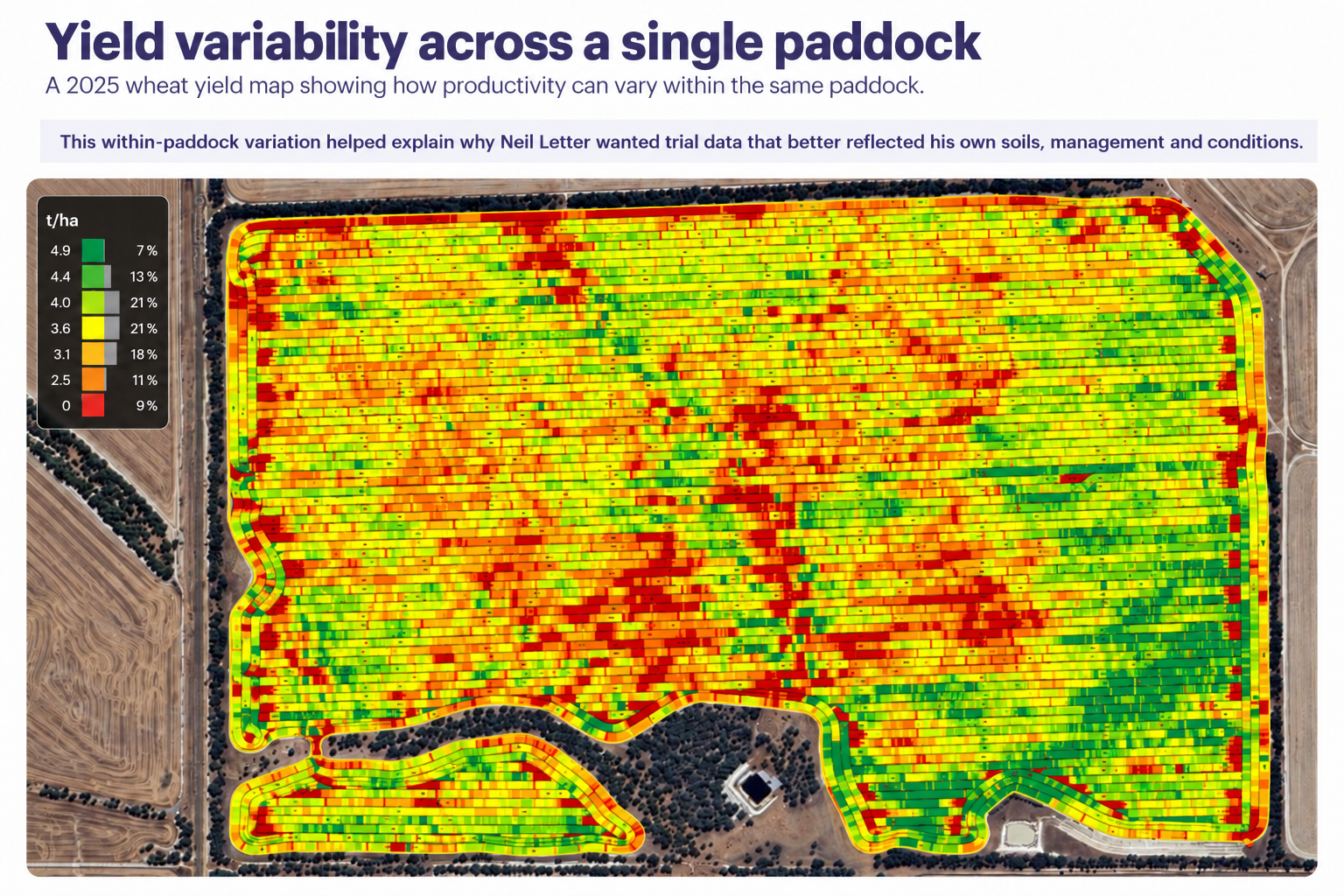
"Some areas of a paddock can yield two tonnes per hectare more than others, so we wanted to understand what was driving those differences and whether we could lift production in the lower-yielding areas," Neil said.
"A lot of trial data comes from small plots on one soil type, whereas running trials across our own paddocks takes into account the different soils and our management history, so we can have more confidence in the results and the decisions we make from them."
Taking the trials into the paddock
Neil's introduction to Laconik came through a community cropping project, where the technology was used to conduct a fungicide trial. Having seen how the system worked, he agreed to undertake fertiliser rate trials across the family's own properties.
During 2025, Laconik supported six trials across six separate paddocks, including four investigating urea rates in wheat and canola and two assessing monoammonium phosphate (MAP) rates in wheat. Each trial included an untreated control and three fertiliser rates, with 63 replications completed across the six paddocks. This replicated approach allowed the business to compare treatment responses under its own paddock conditions, rather than relying solely on results from research conducted elsewhere.
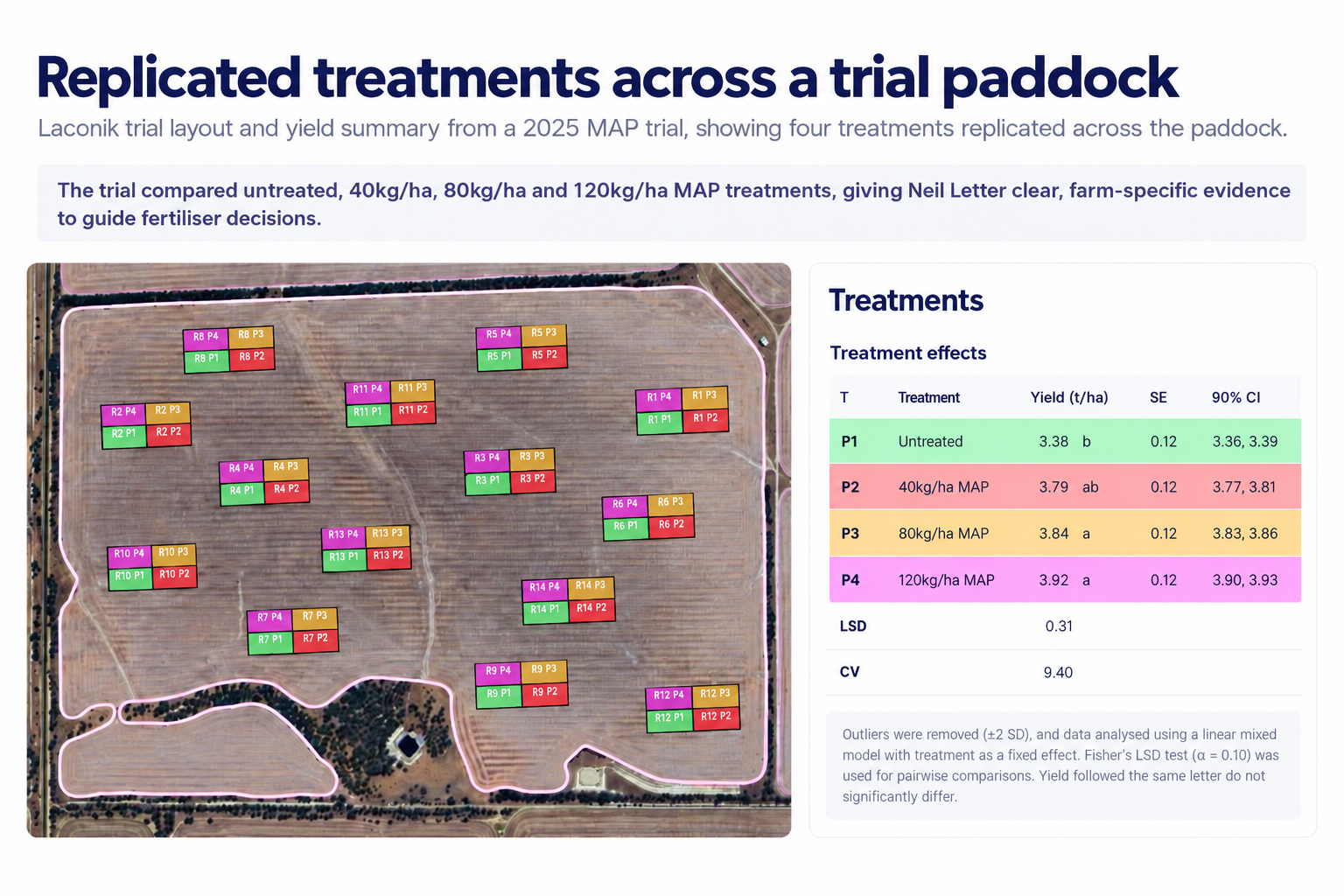
The trials included urea rates of up to 200 kilograms per hectare in wheat and up to 150kg/ha in canola, depending on the paddock. The MAP trials compared rates of nil, 40, 80 and 120kg/ha.
For Neil, a key advantage of Laconik was the ability to incorporate trials into normal farming operations without creating significant additional work. Despite his limited experience with variable rate agriculture technology and some initial troubleshooting with the farm's less common seeder brand, Laconik's technical support made setup relatively straightforward. Once connected, the trials ran through existing machinery as part of everyday paddock activities.
"Laconik Research Agronomist Jack Randall provided great technical support to help us set up the trials and send the prescriptions through to our machinery, so it was a really simple process for us to get everything up and running," Neil said.
"As long as the driver accepted the job, they didn't have to do anything else because the machine just did it."
The ability to analyse results relatively quickly after harvest was another advantage. The speed at which Laconik could analyse trial data and provide results was another advantage, with findings available soon after individual paddocks were harvested.
"I thought we'd have to wait until the end of the season to get all the results back, but Jack was able to give me a summary while we were still going," Neil said.
"We could get the results back almost straight away, which meant we knew how the different treatments had performed without having to wait weeks for a report."
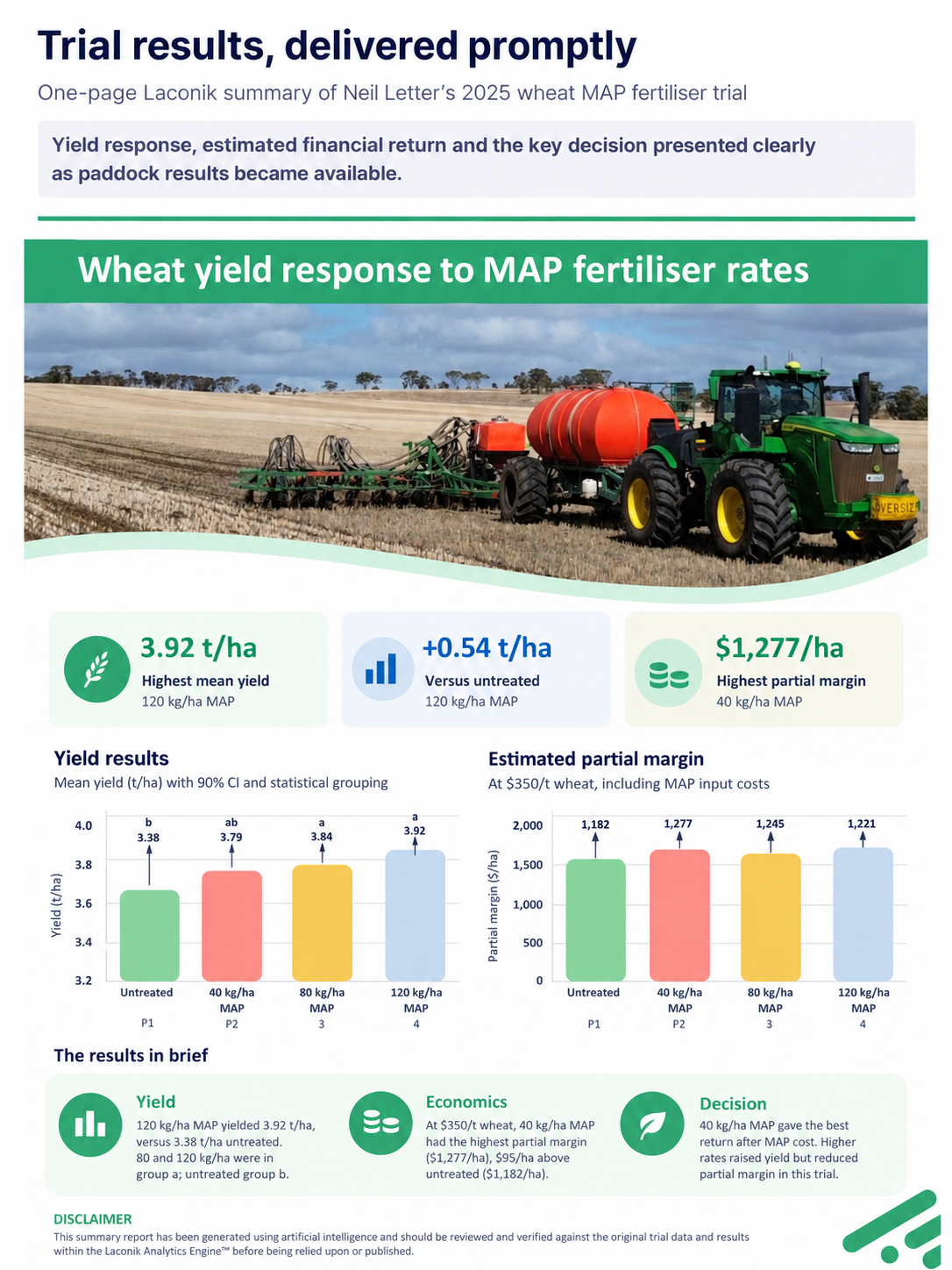
The detailed reports provided technical information about crop responses, but Neil was particularly interested in the financial comparisons.
"I'm not a scientist or an economist, so at the end of the day, I just want to know whether a decision is making or losing us money," he said.
When more fertiliser doesn't mean more profit
The 2025 trials revealed considerable differences in crop response, demonstrating why the same fertiliser rate may not deliver the best economic outcome in every paddock.
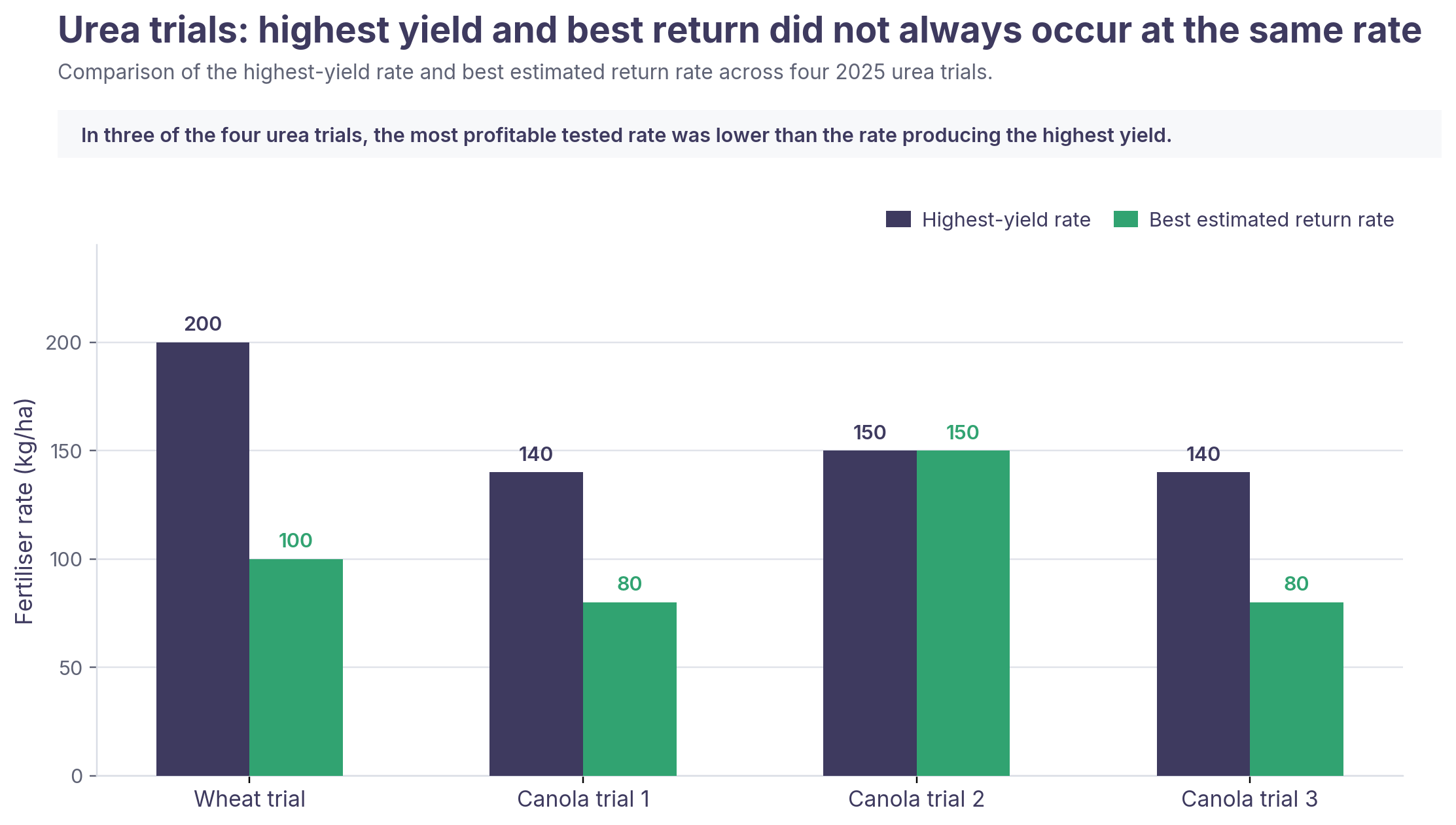
The strongest measured urea response occurred in a canola paddock, where yield increased by 1.03t/ha, from 2.13t/ha without urea to 3.16t/ha at 150kg/ha, which also delivered the strongest estimated financial return. For Neil, the result highlighted the different nutritional requirements of land that had only recently been brought into the family's cropping program.
"We had a massive nitrogen response on some of the newer cropping country, so we're better off putting our money there rather than applying more on paddocks where we're already getting close to their potential," he said.
However, trials on paddocks under the family's longer-term cropping management told a different story. In two canola paddocks, applying 80kg/ha of urea produced yields of 1.84t/ha and 1.83t/ha, compared with 1.86t/ha and 1.85t/ha at 140kg/ha, with the lower rate delivering the better estimated financial return in both cases.
In the wheat trial, applying 200kg/ha of urea yielded 4.82t/ha, compared with 4.60t/ha at 100kg/ha, but the lower rate delivered the better estimated financial return after fertiliser costs.
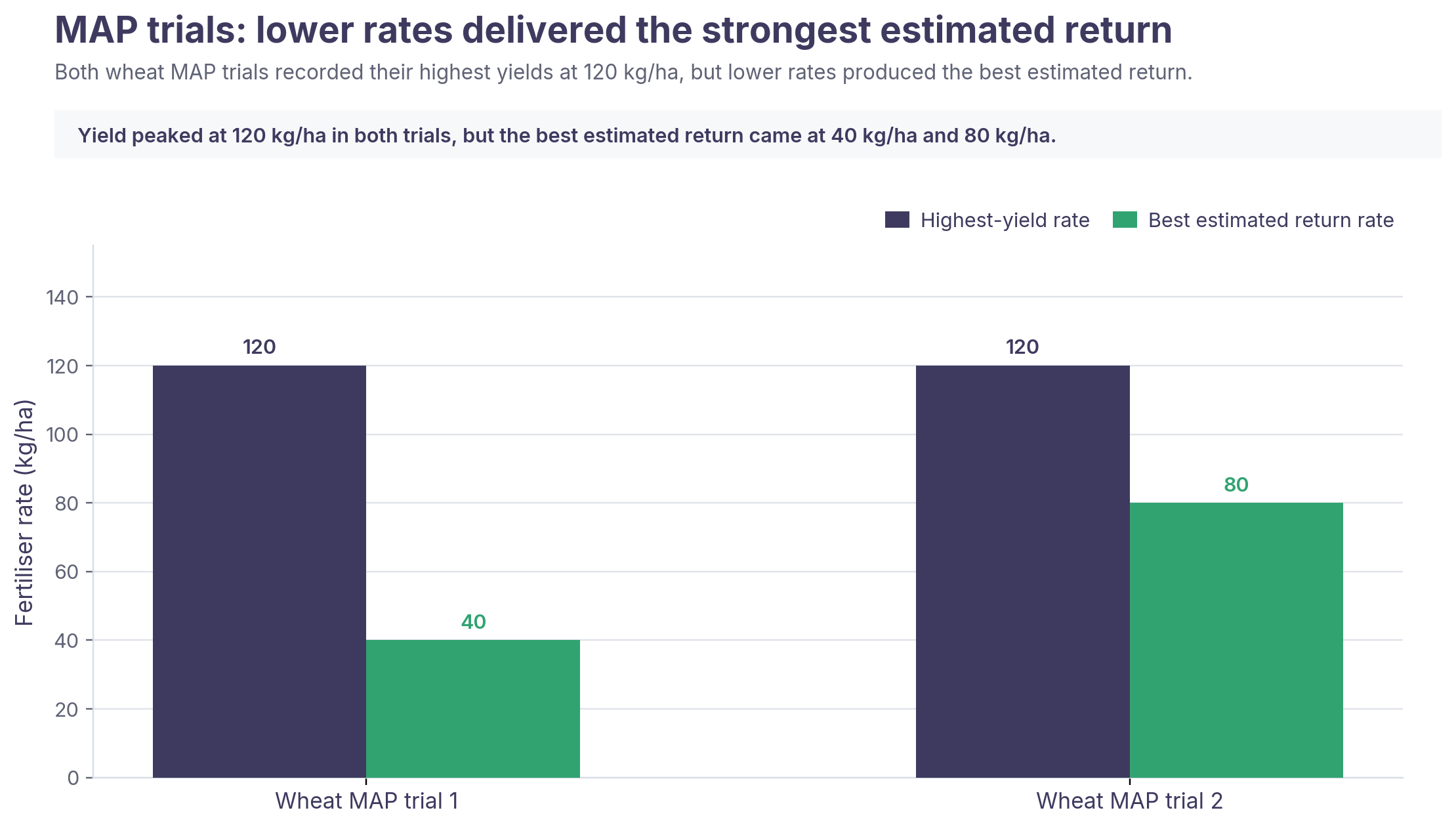
The MAP trials reinforced this finding, with both wheat paddocks recording their highest yields at 120kg/ha, reaching 3.92t/ha and 5.30t/ha respectively. However, those higher yields did not deliver the best financial returns, which were achieved at considerably lower MAP rates of 40kg/ha and 80kg/ha.
"I'd been thinking we might need to increase our MAP rates to keep pushing yields, but the trials gave us the confidence to stick with what we were doing rather than spend more money for very little extra return," Neil said.
"We might be able to grow another three or four per cent, but if it's not economical, there's no point throwing the kitchen sink at it."
Turning trial results into better decisions
The findings also influenced the Letter family's fertiliser decisions throughout the 2026 growing season. Rather than increasing rates across the business, the focus shifted towards directing inputs to paddocks where the trials indicated a stronger response was possible.
"We kept our phosphorus rates much the same because of the trial results, but we adjusted our nitrogen program to put more into the paddocks where we knew we were getting a better response," Neil said.
"The results reflect our own management and paddock history, so we're making decisions based on what's actually happening on our farm rather than relying entirely on trial data from somewhere else.”
While the trials did not necessarily reduce total fertiliser expenditure, they gave Neil greater confidence in his fertiliser decisions. Ultimately helping him identify opportunities to optimise application rates, avoid unnecessary expenditure and direct investment towards paddocks where it is most likely to deliver a better return.
"It's more about the peace of mind, knowing we're getting close to the full potential out of our paddocks and putting our fertiliser where it's going to deliver the best return," he said.
That confidence has encouraged the business to expand its trial activities. During 2026, the family has continued investigating fertiliser responses, including further MAP and muriate of potash (MOP) trials, alongside work examining seeding speed and deep ripping.
Neil is also interested in investigating whether splitting phosphorus applications between pre-seeding and seeding could improve operational efficiency. The proposed approach could potentially reduce the amount of compound fertiliser handled during seeding, although further testing would be required to understand its agronomic implications.
For a business only beginning to explore more sophisticated precision agriculture applications, the trials have provided a practical starting point for building a more detailed understanding of paddock performance.
"The data is only as good as what you do with it, so the next step for us is getting better at analysing the results and using that information to make decisions," he said.
For Laconik, the Letter family's experience demonstrates the value of making replicated trials practical enough to incorporate into commercial farming operations, while providing information growers can use to assess their own decisions. Rather than producing one fertiliser recommendation for the entire business, the trials highlighted where additional inputs were worthwhile, where existing rates were sufficient and where further investigation could guide future decisions.